Restoring Hope During Trying Times
|
By Gretchen M. Spreitzer |
It is common for people to lose a sense of hope during trying times, like September 11, 2001 or in the aftermath of Hurricane Katrina. A loss of hope can cause paralysis and impair any chance of a quick recovery. I have been studying how leaders can create and restore a sense of hope in employees during trying times. Most of this body of research has examined the topic of hope in the context of survivor responses to organizational downsizing. My research, much of it conducted with Aneil Mishra at Wake Forest University, is based on extensive interviews with leaders who have managed at least one downsizing process as well as surveys of individual employees on their experiences in an organizational downsizing.[1] I draw on this research to articulate some implications on how leaders can restore a sense of hope in trying times.
“Hope springs eternal…” British poet, Alexander Pope.
Starting Assumptions
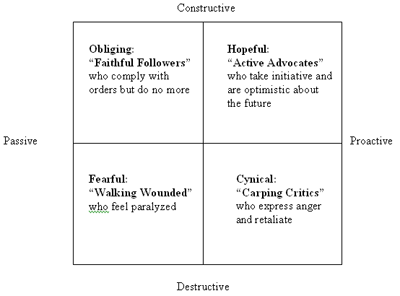
- Survivors can respond to trying times in different ways ranging from very passive to very proactive and from very destructive to very constructive. Juxtaposing these two dimensions results in a typology of survivor responses.
- The most typical survivor reaction is fear. Yet, precisely the opposite response (the hopeful response) is what organizations need to persevere and recover during trying times. Hopeful survivors are proactive and constructive, taking initiative and working in what they perceive to be the best interests of the organization
- Survivors often shift from one response to another as they cope with difficult times. So even if a person reacts fearfully or cynically at first, they can become more hopeful as the situation evolves or with leadership intervention.
- Hope matters because it puts people in a better position to cope with change and remain healthy amidst adversity.
Key Learning: Leadership plays an important role in facilitating hopeful responses. People turn to the leader during trying times and even the smallest leadership actions get noticed. During a crisis, every gets amplified. How you behave now will be remembered for days to come, so consider the following principles to guide your actions now. These principles will help move your people away from despair by mobilizing their capabilities and resources.[2]
What Can Leaders Can Do To Restore Hope in Trying Times?
“I steer my bark with Hope in the head, leaving Fear astern.” In a letter from Thomas Jefferson to John Adams
- Be trustworthy. Trust in leadership
breeds hope by helping to reduce the threat that people typically
experience in trying times.
- Leaders build trust when they are competent and capable of bringing recovery to the organization
- Leaders invoke trust when they keep the promises they make.
- Leaders facilitate trust when they are
open and honest about what is happening. Trust comes from being
visible, and leaders cannot overcommunicate during times of
trouble. Make yourself available and accessible.
- Be fair. Treating people fairly and
justly in the present creates hope in the future.
- How leaders care for the victims of a tragedy provides comfort to survivors. Go the extra mile in caring for victims and their families. Treat people with respect and dignity. Put yourself in others shoes. Express your own sorrow.
- Leaders should shoulder more their share of the burden. This is the time to be generous – whether it be taking a pay cut to start a victims fund or being the first in line to give blood. Your actions will serve as a model for others.
[1] B. Simmons, D. Nelson & J.C. Quick (2003). “Health for the Hopeful: A Study of Attachment Behavior in Nurses.” International Journal of Stress Management, 10: 361-375.
[2] L. Tiger. 1995.
Optimism: The biology
of hope. New York: Kodansha.
[1] Mishra, A.K., and Spreitzer, G.M. 1998. Explaining how survivors respond to downsizing: The roles of trust, empowerment, justice, and work redesign. Academy of Management Review, 23: 567-588.